



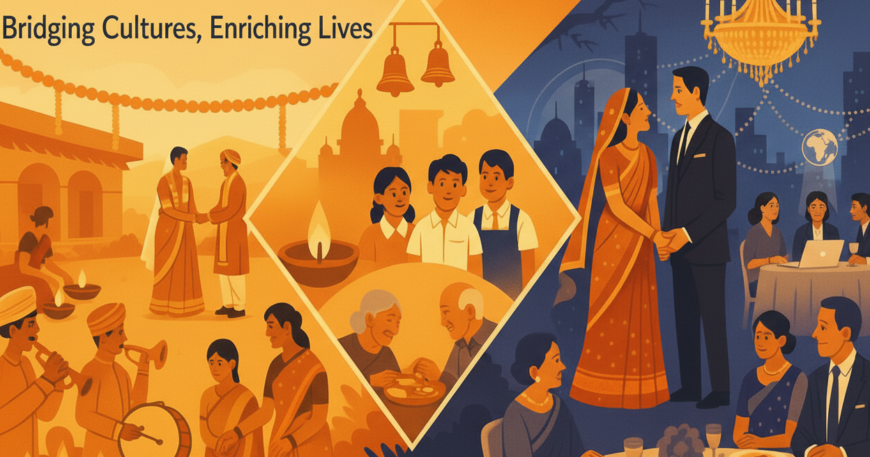
India: A Diamond Society with Cultural-Spiritual Wealth
Introduction The word “poverty” carries heavy baggage in modern global discourse. To Western economists, being poor often means exclusion from consumption, lack of access to branded goods, or inability to live up to a material standard of life. Yet, when the same lens is applied to India, it often produces distortions. India, despite its economic challenges, cannot be simplistically painted as a “banana republic” of stark wealth inequality. Instead, it increasingly resembles what I call a “diamond society”—a nation where there is a growing, thick middle class, a visible wealthy elite at the top, and at the base, millions who may live simply, but not necessarily in misery. What makes this unique is that India’s “wealth” is not only material but also cultural and spiritual. To miss this is to misunderstand the very essence of Indian society. Poverty in the Western Lens In most Western countries, to be “poor” is to be cut off from the mainstream of life. It often translates into: A poor American or European often feels excluded from society’s rhythm—unable to host events, participate in festivals, or celebrate life milestones with dignity. The Western idea of wealth is linear and materialist: you are rich if you consume more, poor if you consume less. The Indian Diamond: Layers of Society In India, the social structure is far more layered and nuanced. If we imagine it visually: What makes India unique is that the base is not hollow. Villages and towns are filled with people who live simply but do not see themselves as destitute, because their lives are interwoven with festivals, spirituality, joint families, and a philosophy of contentment. Example: The Wedding Celebration Perhaps no event captures this better than the Indian wedding. Yet in both cases, the fervor is the same. The music is loud, the lights are bright, the rituals are intact, and the bride’s send-off is equally emotional. Here lies the beauty: happiness is not proportional to expenditure. A villager may spend ₹1 lakh, a businessman ₹1 crore, but the joy in the rituals and community is equally intense. This is not poverty—it is living within one’s means while maximizing joy. Contentment as Wealth The idea that you can be happy within your means is deeply embedded in Indian philosophy. Thus, a family that shares meals together, celebrates festivals, and fulfills duties toward community and guests is considered prosperous—even if their bank balance is modest. Cultural-Spiritual Wealth vs. Material Wealth Consider two households: The difference is profound: in India, even “poor” families are culturally and spiritually rich, often far more socially connected than low-income families in the West. Festivals as Equalizers Take Diwali or Durga Puja. But the essence—sharing sweets, lighting lamps, telling stories of Ramayana or Durga’s victory—is the same. The spiritual joy levels the ground. Similarly, Eid in a village may involve homemade biryani shared with neighbors, while in a city it may be celebrated with lavish feasts. Yet both carry the same heart of togetherness. The Hindu Way of Life: Evolution, Not Rigidity Another reason India cannot be reduced to “poor vs. rich” binaries is the flexibility of its civilizational philosophy. Unlike Abrahamic religions that often emphasize strict scripture, the Hindu way of life is: This flexibility means that Indians can live happily at different material levels without feeling “lesser.” The farmer and the CEO may celebrate the same Diwali with different scales but similar devotion. Why Western Lens Misreads India Western observers often miss this because their benchmarks are different: By these measures, India looks poor and unequal. But if you measure cultural participation, spiritual resilience, and community bonding, India looks far richer. It’s why a villager with two cows, a field, and a family around the chulha (hearth) may feel happier than a Western worker in a lonely apartment. India’s Diamond Society in Action Together, this forms a diamond: not a pyramid of misery, but a society where even the bottom has richness of life beyond GDP numbers. The Philosophy of “Happiness Within Means” At the core of this lies an Indian ethos: santosha—contentment. This is the genius of Indian civilization: to democratize joy through culture and spirituality, not just money. Lessons for the World As global inequality rises, India’s example has lessons: Conclusion India is not a banana republic. It is a diamond society, with a broadening middle class, a visible elite, and a base that may look “poor” in Western eyes but is sustained by a treasury of culture, spirituality, and community. The West often defines poverty as the inability to consume. India redefines it: to live within one’s means, to celebrate with dignity, and to find joy in culture, family, and faith. This is why, in India, even the humblest family lights its diyas, plays its bands, serves its food, and sends off its daughter with as much pride as the richest man in the city. This is not poverty. This is civilizational wealth. And this—perhaps—is India’s greatest export to the world. An Invitation to Experience At Le Frehindi, we believe that this essence of India—simple living, high thinking, and cultural-spiritual wealth—is best understood not through textbooks but through experience. This is why we actively promote experiential trips for Western students to visit India and see how joy, dignity, and freedom can thrive within modest means. To live in a village, celebrate local festivals, eat at family tables, and participate in weddings or community rituals is to understand a truth that India has carried for centuries: happiness is not about how much you spend, but how much love and meaning you create. If you are a school, a parent, or a Westerner who would like to take part in such programs, do write to me at: ceo@lefrehindi.com Come, discover India’s diamond society—where you can be happy, free, and guiltless in living simply within your means. Haru Mehra President, Le Frehindi